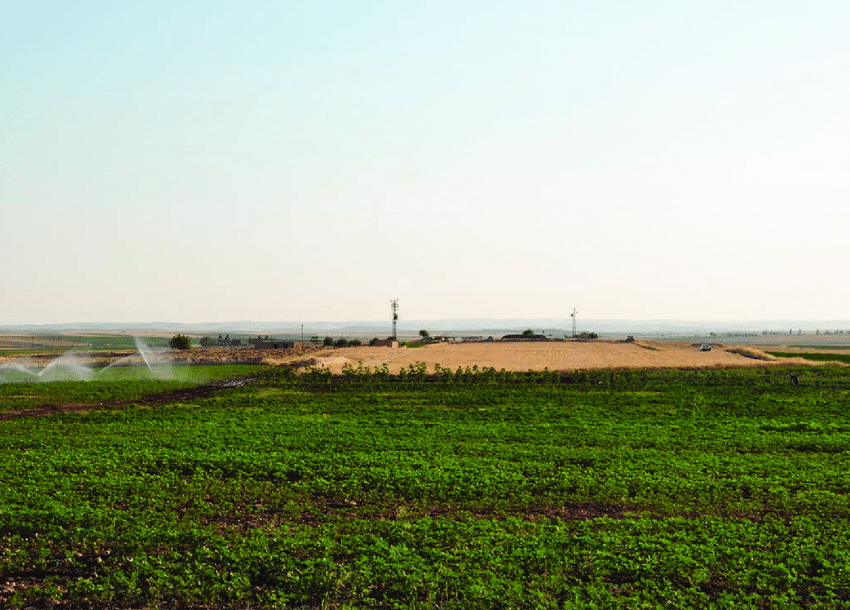
Taşlı Tepe is located circa 1 km north of Basbük village located approximately 65 km northeast of Şanlıurfa, within modern borders of Siverek district . This settlement site was discovered for the first time in 2011 during provincial cultural inventory studies39. Altitude of Taşlı Tepe settlement above sea level is 740 m. The settlement covers an area of circa 12 decares. The land on which the settlement is founded is currently used for agricultural purposes. The settlement is surrounded with high plateaus from north and east. The southern and western parts rather demonstrate a partially smooth terrain. When we look at the lithic tools discovered from Taşlı Tepe as a whole, typologically toll varieties from Pre-Pottery Neolithic period can be seen, which are Byblos type arrowheads made of Flintstone, lower and upper grinding stones, stone dish, hand axe made of boulder, small chisel, pestles and stone vessels40. Moreover, a bead in the form of a bull head made of green boulder stone was also discovered.
The most interesting finds excavated at Taşlı Tepe settlement are the “T” shaped pillar fragments located in the courtyard of a house in Başbük village. “T” shaped pillar fragments were revealed at an excavation of approximately 7 m x 8 m to 1 m depth at the southeast hillside of the settlement. All pillars are made of limestone. One of the pillars unearthed in fragmented form was reassembled and identified to be 152 cm long, 93 cm wide at the capital part with a thickness of 22 cm. Based on the dimensions of the pillars discovered at Taşlı Tepe, the settlement is contemplated to be contemporaneous with Layer II of Göbekli Tepe and the cult building discovered in Nevali Çori. Moreover, the pillars from Taşlı Tepe settlement are approximately of the same size with the pillars from Karahan Tepe, Göbekli Tepe Layer II, Sefer Tepe, Hamzan Tepe, Kurt Tepesi and Harbetsuvan Tepesi. No relief or scraping marks of any kind were encountered on the Taslı Tepe pillars. A fragment of terazzo floor specimen was also discovered at the same site.
Taslı Tepe settlement should be dated as late PPNA and early PPNB due the similarities with Layer II of Göbekli Tepe and the cult building pillars at Nevali Çori.
Text Source (Doç. Dr. Bahattin ÇELİK): TÜBA–AR, Türkiye Bilimler Akademisi (TÜBA