Ayanlar Höyük
by Jews, Christains and Muslims alike.
Though a sacred city for most, you see all generations
enjoying the lighter side of the ancient city. The sanctity allows for play.
world class at easily reachable on foot.
yet prevailed, lays in rest here in Şanlıurfa.
yet prevailed, lays in rest here in Şanlıurfa.
yet prevailed, lays in rest here in Şanlıurfa.
yet prevailed, lays in rest here in Şanlıurfa.
Ayanlar Höyük was first discovered during surface surveys conducted in 2013 (Güler, Çelik 2015.83– 84, Res. 11–13; Çelik 2014a.19; 2014b.318). Ayanlar Höyük is the largest mound from Neolithic period known in the region and is located west of Sanlıurfa. As a result of the research conducted in the south-eastern part of Ayanlar Höyük, settlements with characteristics that can be dated to the Neolithic Period were determined at distances ranging from 2 to 7km (Çelik 2014a.19; 2014b.317–318; 2015a.446–447; 2015b.356–357; Güler, Çelik 2015.82–83).2 These are mostly small-scale settlements. It is estimated that the mound of Ayanlar – the eastern, western and northern sections of which have yet to be investigated – was a big centre in its region.
During the studies conducted in the region in 2015, it was understood that the three artefacts (Ercan, Çelik 2013.Res. 1–3, Fig. 1–2) brought to the Sanlıurfa Museum in 2013 and dated to the Pre-Pottery Neolithic Period were unearthed from Ayanlar Höyük. Ayanlar Höyük is the third largest mound dated to the Pre-Pottery Neolithic Period after the previously known Göbeklitepe and Karahan Tepe in the region. With the discovery of Ayanlar Höyük, which stands out with its area of approx. 14ha (Güler, Çelik 2015. Fig. 13; Çelik 2015a.447; 2014b.318; 2014a. 19; 2015b.357) , the number of large-scale settlements dating to the Pre-Pottery Neolithic Period of the region now stands at three.
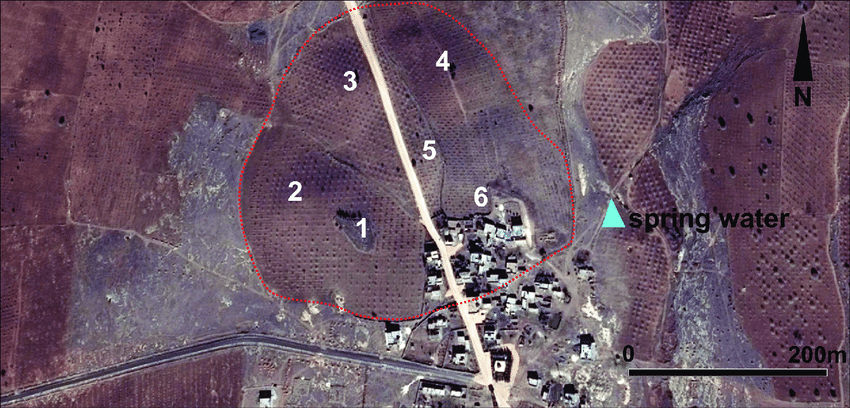
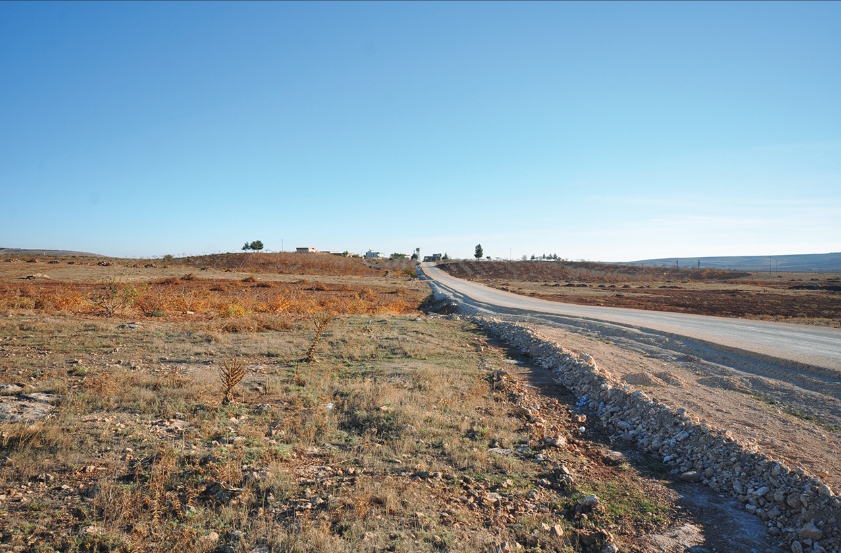
This discovery demonstrates once again that multiple large-scale settlements existed in the region during the Neolithic Period. Location The settlement is located partially underneath the northern part of Ayanlar Mahallesi, which is located within the boundaries of Karaköprü county, about 30km west of Sanlıurfa (Çelik 2015a.447) 5 by the motorway route (Fig. 1). The settlement was first discovered during a surface survey conducted in 2013 (Güler, Çelik 2015.83–84; Çelik 2015a. 447– 448; 2014a.19). Ayanlar Höyük’s lies 733 metres a.s.l.. The mound is 250 x 300m and presents a broad and shallow structure which contains six small hillocks (Fig. 2). One of these hillocks contains a small burial ground thought to be in use recently and during the Byzantine period (Çelik 2015a.448). The mound is covered with cultivated soil approx. 10m above the bedrock. Pistachio orchards cover the land over the mound, as arable land is scarce in the region. A north-south road cuts through the centre of the mound, and an asphalt road runs on the southern part of the mound (Fig. 2).
The geological structure of the region comprises entirely calcareous stratigraphy. However, there is a high plateau 2km east of the mound with massive outcrops of basalt (Güler, Çelik 2015.84; Çelik 2015b.357). This region is in the form of a basalt-covered plateau known as Mt. Kasmer, with an elevation of approx. 910 metres a.s.l. Flintstone deposits are not encountered in the vicinity of the settlement site. Therefore, it is thought that the inhabitants obtained their flint from another region. Slightly inclined calcareous plateaus extend to the south, west and north of Ayanlar Höyük. An investigation of the geographical location of the mound shows that the surrounding area has generally turned into barren and rocky terrain due to soil erosion, with very scarce arable land. In addition, it is also reasonable to mention that the Ayanlar site was founded close to water springs. As a matter of fact, the existence of a cave carved some 30m into the bedrock during early or middle Byzantine period to obtain water has been discovered in a valley south of the settlement (Çelik 2014b.318, Res. 14). This valley is also the origin of a stream bed through which seasonal rainwater flows down to the Harran Plain (Map 1). Thus far, only the south-eastern section of Ayanlar Höyük has been investigated. Approx. seven sites were identified in this area (Çelik 2015a.446–447; 2014b.317–318) 6; six are dated to the Neolithic period. Four settlements – Hasan Sırtı (Çelik 2015b.35, Pl. 4.i–l), Ömer Altundag Tarlası (Çelik 2015b.357, Pl. 4.e–h), Çillo Mevkii 1 (Çelik 2015a.446; 2015b. 356, Pl. 3.a–k) and Çillo Mevkii 2 (Çelik 2015a.446; 2015b.356, Pl. 3.l–t) – are characterised as hillside settlements. The remaining two settlements, Domuzcurnu Tepesi (Çelik 2015a.447, Fig. 17) and Nebi Tarlası (Çelik 2015a.447), on the other hand, were founded on slightly higher hills. Out of these six Neolithic settlements, only Domuzcurnu Tepesi is reliably dated to the Pre-Pottery Neolithic period (Çelik 2015b.356, Pl. 3.u–z). Although several finds from the Pre-Pottery Neolithic were recovered from other settlements, such sites tend to present the characteristics of the Pottery Neolithic. A similar fact concerning the Neolithic sites located south of Ayanlar Höyük also applies to Sefer Tepe and the surrounding area (Güler et al. 2013.297, Map. 1). This suggests that Ayanlar Höyük might also be a site that should be characterised as a largescale centre like Sefer Tepe (Atakuman 2014.9, 26; Benz, Bauer 2014.15, 18).
Ayanlar Höyük is another settlement founded on bedrock, just like the Pre-Pottery Neolithic sites in the region, such as Karahan Tepe, Nevali Çori, Göbekli Tepe, Sanlıurfa-Yeni Mahalle, Harbetsuvan Tepesi, Kurt Tepesi, Taslı Tepe, Sefer Tepe and Hamzan Tepe (Çelik 2014a.22). The settlement is half a day’s walk to several Pre-Pottery Neolithic sites in the region. The settlement is some 45km from Göbekli Tepe, 25km from Nevali Çori, 30km from Sanlıurfa-Yeni Mahalle and 35km from Hamzan Tepe (Map 1).
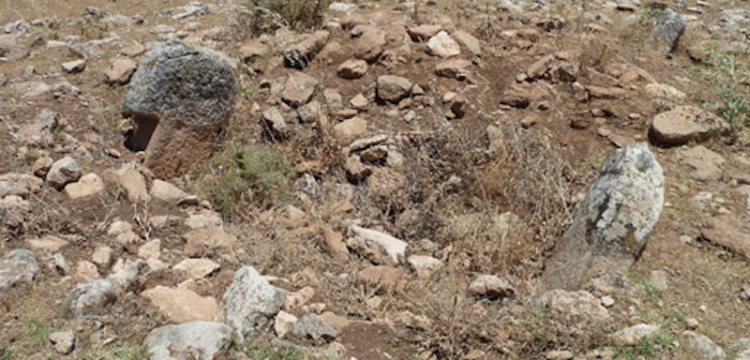
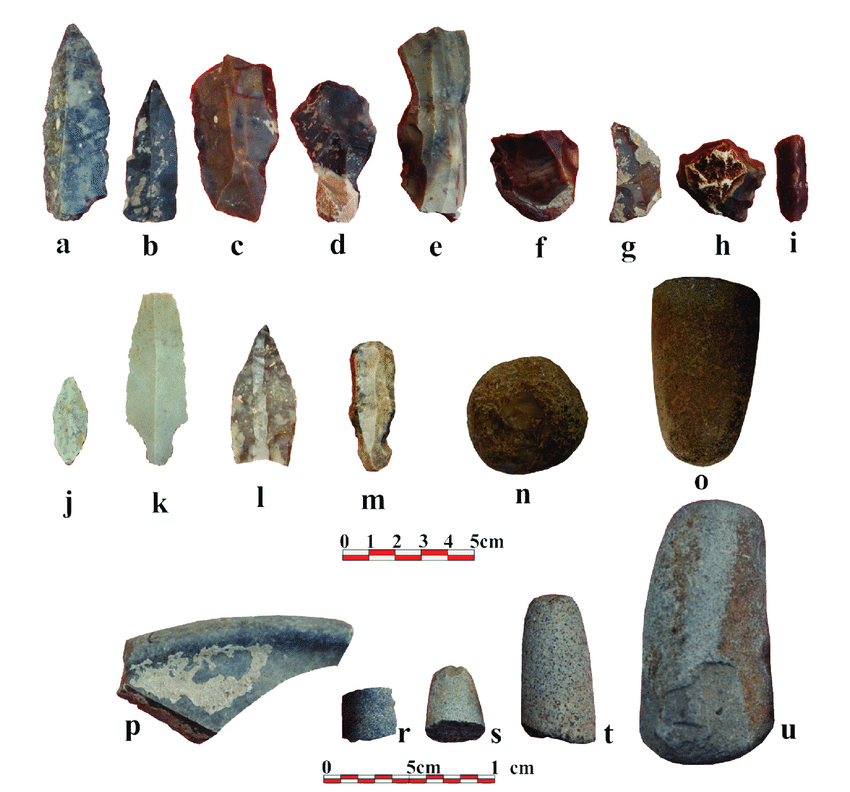
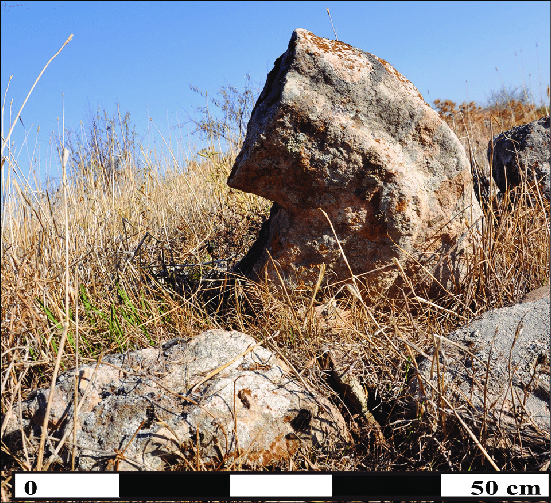
Ayanlar Höyük finds The surface surveys conducted in Ayanlar Höyük led to the identification of two periods, the Pre-Pottery Neolithic period and Byzantine period. The early and middle Byzantine period is rather confined to a small area below and around the village (Fig. 2.6). The ceramic finds from this period tend to be concentrated around the village. Headstones and a village cemetery dating to the early Byzantine period were discovered on hill 1 of the mound (Fig. 2.1). Flint and obsidian tools, top and bottom grindstones, pestles and stone axes were discovered in all other areas of the mound. Architectural finds A harvested stone from Pre-Pottery Neolithic period was discovered in the village cemetery on hill 1 of Ayanlar Höyük (Figs. 2.1 and 3). Stones similar to this one were also discovered at Göbekli Tepe (Schmidt 2010.Fig. 21) and Karahan Tepe (Fig. 4). This is a shaped stone that could be used as a window or door. This stone is believed to be a porthole observed inside cult buildings (Schmidt 2010.250). A harvested stone cube used in the village was also identified (Fig. 5). In terms of dimensions, this cube is similar to the cubes from the Göbekli Tepe Layer II, which are thought to have been used mainly in feasting ceremonies (Dietrich et al. 2012.687, Fig. 11). Small finds Most of the small finds recovered from Ayanlar Höyük consists of flint cores, chips, blades and debitage (Fig. 6.a–i). No Neolithic ceramics were found.
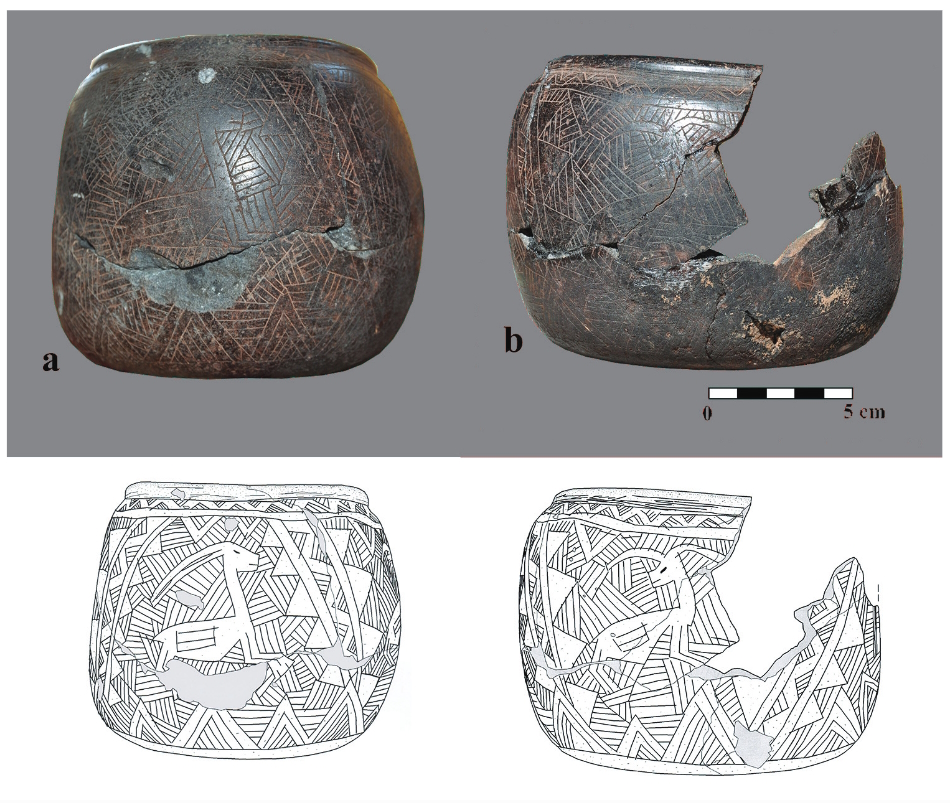
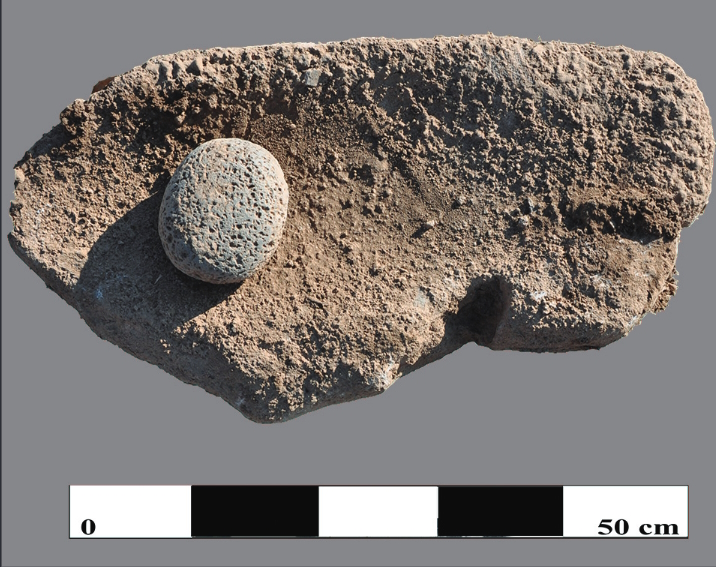
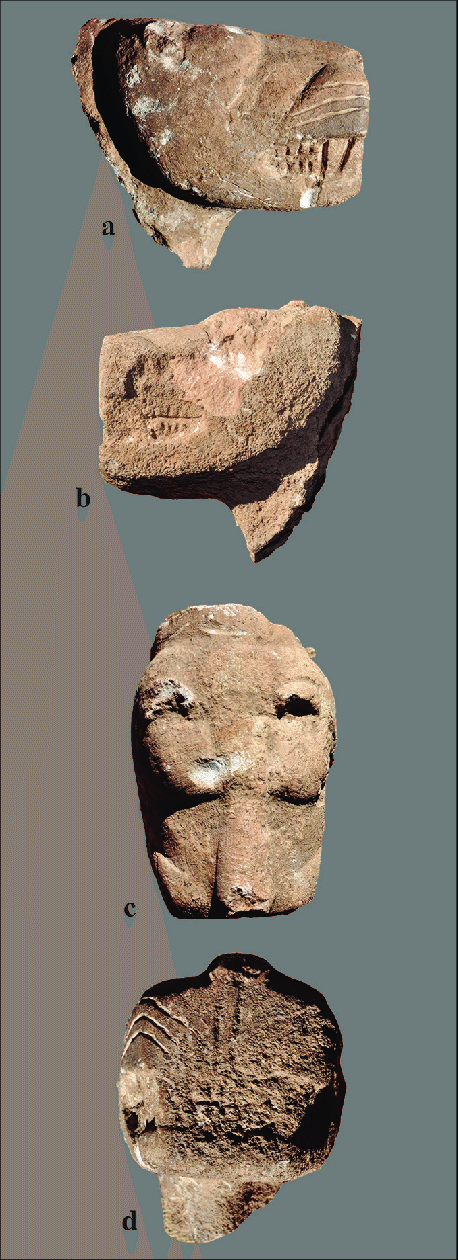
A very small number of obsidian finds was recovered from the settlement in the form of chips and debitage. Moreover, Byblos- and Nemrik-type arrowheads, a stone chisel, end-scraper and hammer were discovered amongst the flint finds (Fig. 6.j–n). If we consider the flint tools as a whole, we observe types of tools peculiar to the Pre-Pottery Neolithic period from topological aspect. In particular, Byblos-type and Nemrik-type flint arrowheads were also found in the region at Göbekli Tepe (Beile-Bohn et al. 1998. Abb. 23.3; Schmidt 1988. Fig. 8; 2001.52, Fig. 10/3, 11/5), Sanlıurfa-Yeni Mahalle (Çelik 2000.Fig. 5.1; 2007.Fig. 20/6; 2011a.Fig. 20), Hamzan Tepe (Çelik 2010.Fig. 9.5,7,10,17,18) and Karahan Tepe (Çelik 2011b. Fig. 18 type I–1). The other stone finds recovered from the site are top and bottom grindstones (Fig. 7), pestles (Fig. 6. r–u), a hatchet made of pebble (Fig. 6o), stone dishes (Figs. 8 and 6.p), a decorated stone vessel fragment (Fig. 9.a–b), a stone cube (Fig. 8) and a piece of a sculpture thought to be the head of a leopard (Fig. 10.a–d). A decorated stone vessel (Fig. 9.a–b), (Ercan, Çelik 2013.Pic. 1a–d, Çiz. 1a–d) and a stone dish (Fig. 8), (Ercan, Çelik 2013.Pic 2, Çiz. 2) discovered at Ayanlar Höyük and currently on display at Sanlıurfa Museum of Archeology present great similarities with the finds recovered from Körtik Tepe site (Özkaya, San 2007.21–36).
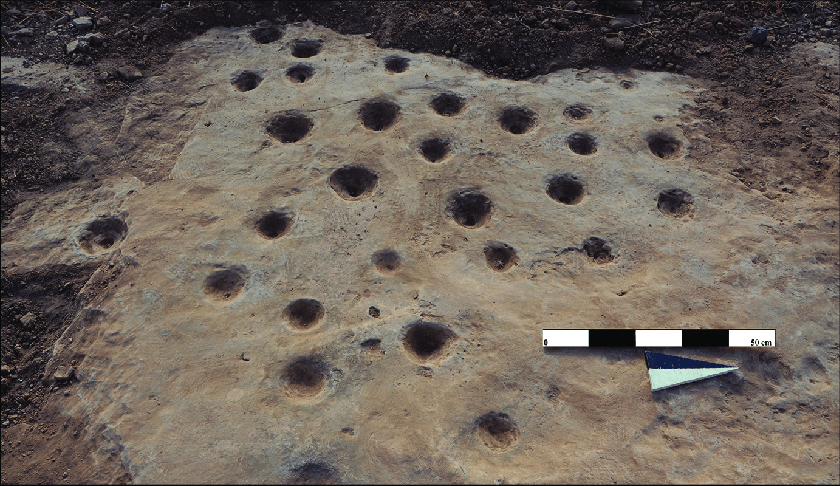
Moreover, a fragment of a sculpture of dimensions thought to be a leopard on display at the same museum was also recovered from Ayanlar Höyük (Fig. 10.a–d). All the aforementioned artefacts were considered to be recovered from I˙nlice (Kurtharabesi) village, located approx. 10km south of Ayanlar Höyük. However, the surface survey carried out at this village revealed no signs of settlement. It was later ascertained that such finds had been transported to I˙nlice village from Ayanlar Höyük by a villager.7 Groups of hollows carved into the bedrock were encountered on the rocky terrain located south of the mound (Fig. 11). Similar groups, thought to be a technique employed for constructing pools, are recognised and known in the region from Göbekli Tepe (Schmidt 2007.Fig. 5), Karahan Tepe (Çelik 2011b.Fig. 5; 2015.Fig. 27) and Hamzan Tepe (Güler, Çelik 2015.Res. 15; Çelik 2015.Fig. 23). Another interesting find discovered in the graveyard on Ayanlar Höyük is a stone fragment considered to be an entrance gate or window to cult areas, maybe a porthole (Fig. 3). A similar find was also recovered from the surface of Karahan Tepe (Fig. 4).
Moreover, identical finds were also encountered at Göbekli Tepe (Schmidt 2010.250– 252, Fig. 21, 23–24). Such stone finds were usually recovered from settlements where cult buildings are present (Schmidt 2010. 250, Fig. 23). Thus far, no ‘T’-shaped pillars have been discovered at Ayanlar Höyük; however, the discovery of pillar pedestals at the settlement increases the probability of finding ‘T’-shaped pillars here. Another artefact that supports this fact is the sculpture fragment thought to depict the head of a leopard (Ercan, Çelik 2013.21, 35–36, Pic. 3a–d). This fragment is very similar to finds recovered from Göbekli Tepe (Schmidt 2007.Fig. 23) and Nevali Çori (Hauptmann 2007.Fig. 20). Moreover, such sculptures are generally found in cult buildings (Schmidt 2010. 251, Fig. 23). Conclusion The stream that flows from the basin area of Mount Kasmer, located east of Ayanlar Höyük, featuring a basaltic structure is known as Karakoyun Stream (Çelik 2007.15, Fig. 3; 2011a.139, Fig. 3) 8. In the Neolithic, this stream, the course of which was altered in the Byzantine period, flowed just upstream from the Sanlıurfa-Yeni Mahalle (Balıklıgöl Höyügü) settlement (Çelik 2007.165–178; 2011a. 139–164). Therefore, the valley through which the Karakoyun Stream flows probably acted as a linking route between Sanlıurfa-Yeni Mahalle Höyük and Ayanlar Höyük. The three artefacts (Ercan, Çelik 2013.13–24) identified as from Ayanlar Höyük before being delivered to Sanlıurfa Museum are important, as such artefacts demonstrate the possibility for the presence of cult buildings at this settlement. In particular, the sculpture fragment depicting the head of a lion/leopard among such artefacts greatly resembles the alto relievo lion located in Building C at Göbekli Tepe (Schmidt 2011.48, Fig. 28). Furthermore, the sculpture also has characteristics similar to those of the lion reliefs in the Lion Building (Schmidt 1998.30– 31, Abb. 9–10). The recovery of the decorated stone vessel from Ayanlar Höyük, which is currently on display at Sanlıurfa Museum, is also important because this is an indication that the burial traditions practiced at Ayanlar Höyük had characteristics similar to those at Körtik Tepe.
In addition, although only four or five decorated stone vessel fragments have been recovered from the excavations at Göbekli Tepe, an almost intact stone vessel was recovered from Ayanlar Höyük. The presence of all these finds suggests that Ayanlar Höyük might be a large-scale settlement that will yield substantial finds. So far, the finds recovered from Ayanlar Höyük indicate that the settlement has characteristics identical with Layer II of Göbekli Tepe. However, taking into consideration the 10m of cultivated soil covering the settlement, it is highly possible that similar finds from Layer III of Göbekli Tepe will be found. In conclusion, the abundance and high-quality of the finds from Ayanlar Höyük resembling the finds from Göbekli Tepe and Karahan Tepe indicates that this settlement was an extensive Neolithic centre.
Moreover, the surface area of the settlement, some 14ha, and the presence of small hills thereon, as at Göbekli Tepe and Karahan Tepe, shows that Ayanlar Höyük was an extensive settlement during the Neolithic period, like Göbekli Tepe and Karahan Tepe. Ayanlar Höyük should be dated between the early Pre-Pottery Neolithic B period (EPPNB) and mid-PrePottery Neolithic period (MPPNB) in the light of the finds recovered there.
Text Source: A new Pre-Pottery Neolithic site in Southeastern Turkey> Ayanlar Höyük (Gre Hut) Bahattin Çelik.


